
October 21, 2026 — Japan’s spacecraft has passed its first critical operations phase. Its destination is Phobos, a small moon of Mars, and its most important cargo is something it has yet to collect.
Japan’s Martian Moons eXploration (MMX) mission has begun an ambitious journey: studying the moons of Mars, touching down on Phobos and bringing some of its material back to Earth. Those grains could help scientists work out how the moons formed and what their history reveals about the wider Martian system. NASA’s mission overview describes the spacecraft’s scientific goals.
There is a satisfying contrast at the centre of the mission. The journey is interplanetary; the intended return is a small collection of rock and grains. The value lies in what researchers could learn from examining that material closely, alongside the measurements made where it came from.
What has happened so far?
MMX lifted off from Japan’s Tanegashima Space Center aboard H3 Flight 10 at 4:41 a.m. Japan Standard Time on October 20. That was October 19 in Toronto. JAXA confirmed that the spacecraft separated from the rocket about 71 minutes after launch. JAXA’s launch announcement establishes that first milestone.
The next update came on October 21: JAXA reported that the initial critical operations sequence had been completed successfully and that the spacecraft was in good health. Equipment checks and preparations for the outbound cruise were next. JAXA’s operations update is the latest operational status used for this article.
Reaching the Mars system, working close to a small moon, collecting suitable material and returning it safely remain separate challenges. The launch and early operations have cleared the first steps; the later work is still ahead.
Why go to Phobos?
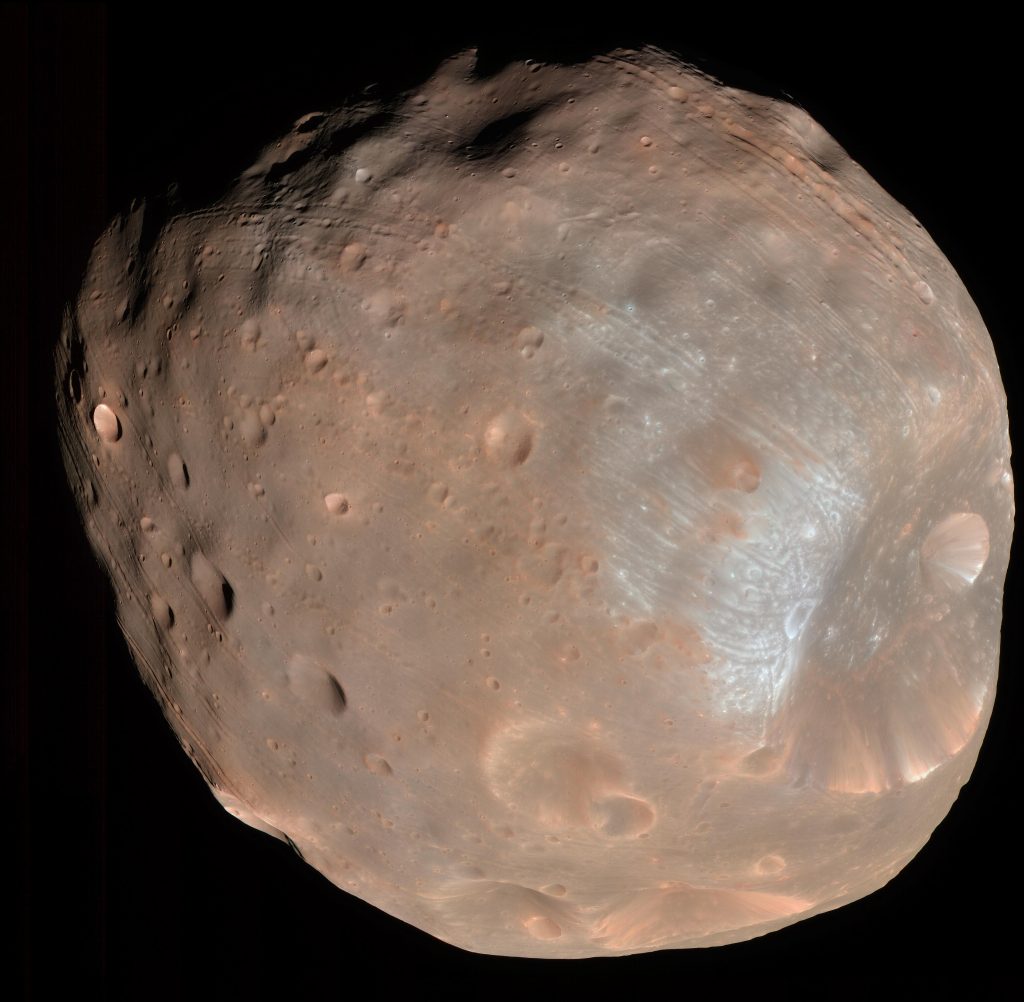
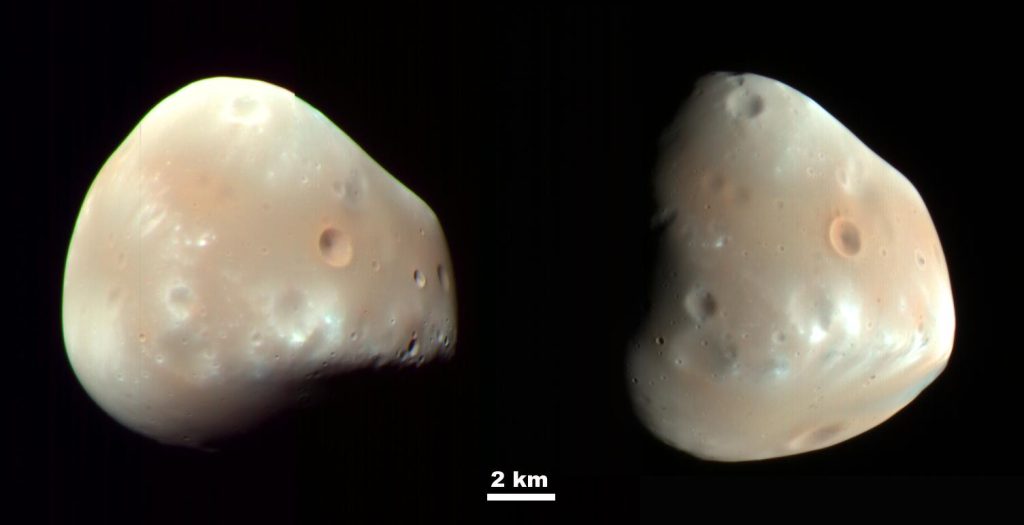
Mars has two small moons, Phobos and Deimos. Phobos is the larger, but “larger” is relative: it is an irregular body reaching only about 27 kilometres across. Its dark, cratered surface offers an intriguing scientific problem. Where did this little world come from?
Two leading explanations point to very different histories. Under the capture hypothesis, the moons began as asteroids and were caught by Mars’s gravity. Under the giant-impact hypothesis, a major collision with Mars sent debris into orbit, and the moons formed from that material. JAXA sets out both possibilities in its MMX science overview.
These ideas are useful because they make the composition of the moons matter. Material that originated elsewhere in the Solar System would tell a different story from material assembled after a collision involving Mars. Researchers need evidence that can distinguish those histories, combining what they see on the surface with what the material contains.
Phobos also offers a practical route into this investigation. JAXA describes small-body exploration as a way to build on experience from its Hayabusa missions. Returning material from a moon with weak gravity presents a different engineering problem from lifting it off the surface of Mars. The agency’s mission plan explains why Phobos is the sampling destination.
Why bring the material home?
Images can show a crater, a ridge or an area that reflects light differently. Instruments aboard a spacecraft can measure properties of the surface. A returned sample adds another kind of evidence: the material itself, available for examination in laboratories on Earth.
The mission’s collection goal is at least 10 grams. It is a target, not an amount already obtained. JAXA’s plan combines observations near Phobos with that physical sample, so the grains can be studied in relation to their surroundings. JAXA’s mission overview describes that combination.
Think about the questions in order. What is a grain made of? What does its composition suggest about its history? Does that interpretation fit the place where it was collected and the observations of the rest of the moon? The strength comes from connecting answers, not from treating one intriguing particle as a complete biography of Phobos.
A scientific planning paper by the MMX Sample Analysis Working Team describes examinations of mineral structure, chemical composition and isotope ratios. Isotopes are different forms of the same element; their proportions can help researchers compare possible origins. Analyses of suitable grains could also constrain when impacts, heating or alteration involving water occurred. Those are proposed investigations, not results already obtained from Phobos. The team’s analysis paper explains the questions these methods are intended to address.
The team also has to distinguish signals from Phobos from anything introduced during construction or handling. Its contamination-control plan describes limiting material from Earth, checking for it and preserving reference materials that could help identify contaminants later. An interesting chemical finding needs that background before researchers can interpret it confidently.
If the return succeeds, the scientific work will continue after the flight. The plan is for the capsule to land in Australia and then travel to JAXA’s Institute of Space and Astronautical Science in Japan. Material would be extracted, catalogued and made available for investigation. ESA’s mission factsheet describes this planned path from recovered capsule to research sample.
The map matters as much as the scoop
Before collecting anything, the team needs to understand the terrain. A scientifically interesting location also has to be a place where the spacecraft can attempt its operations.
One instrument helping with the broader picture is MEGANE, developed by the Johns Hopkins Applied Physics Laboratory with Lawrence Livermore National Laboratory. It measures neutrons and gamma rays emitted from Phobos to investigate the surface’s elemental composition. Those measurements are intended to provide clues about the moon’s origin. NASA’s account of the instrument explains its role.
This helps clarify why a sample-return mission involves so much observation before the return. A sample gives an intimate view of a small amount of material. Measurements across the moon provide the setting in which that material can be understood. Neither makes the other redundant.
Two approaches to collecting a sample
MMX carries complementary sampling systems. The P-Sampler, contributed by NASA, uses bursts of pressurised nitrogen gas to gather material from the surface. JAXA’s C-Sampler collects material by coring below it. The two systems are described in the sampler team’s technical overview.
The gas-driven design addresses a practical difficulty: in very weak gravity, pushing a tool against the ground is not like digging here on Earth. The sampler’s manufacturer explains that nitrogen loosens grains and carries them into a collection chamber. That is its intended mechanism, still to be put to work on Phobos. The complementary coring tool gives researchers access to material below the surface.
It is also a reminder that collecting a sample is a physical operation, not just an instruction transmitted from Earth. The spacecraft must reach the selected place, interact with an unfamiliar surface and retain what it collects. The returned material will need to be interpreted alongside records of where and how it was acquired.
Meet IDEFIX, the rover that goes first
IDEFIX is the small rover travelling with MMX, developed jointly by Germany’s DLR and France’s CNES. It is intended to explore Phobos before the main spacecraft’s sampling operations. DLR’s current plan places its surface mission around the turn of 2028–2029, with approximately 100 days of exploration. DLR’s launch report describes those objectives.
Weak gravity is an opportunity for sample return, but it complicates ordinary-sounding activities such as landing and driving. The plan is to release IDEFIX above the surface, let it descend and bounce, and have it right itself before beginning operations. Once moving, it must maintain contact with the ground while dealing with uncertain loose material. DLR’s wheel-engineering account explains why careful movement and traction matter so much.
Its instruments are designed to examine both the material and how the surface behaves. Cameras look ahead and at the interaction between the wheels and the ground. A Raman spectrometer investigates mineral composition, while a radiometer measures thermal properties. The rover team’s 2026 scientific overview sets out those jobs.
That makes IDEFIX more than a vehicle carrying a camera. Observations from close to the ground can connect the view from above with the place where the larger spacecraft hopes to work. Watching what happens around a wheel can supply useful evidence about terrain that otherwise exists mainly as distant measurements.
Could a moon sample tell us about Mars itself?
It could, although the route is indirect. Research described by JAXA’s Institute of Space and Astronautical Science examines how impacts on Mars can eject material that later reaches Phobos. A sample from the moon could therefore contain material with a Martian origin, alongside material belonging to Phobos itself. This is a scientific expectation to investigate, not a confirmed description of the sample MMX will eventually collect. ISAS’s explanation of the research describes that possibility.
The distinction affects how we should read future discoveries. Material collected directly from a known place on Mars comes with one kind of geographical context. A grain recovered on Phobos raises an additional question about how it got there. That does not make it unhelpful; it makes its journey part of the scientific problem.
The planned timeline—and what could change
NASA’s mission feature, updated on October 20, gives the broad schedule below. These are planned milestones, not appointments that remove the uncertainties of operating a spacecraft.
- Launch and initial critical operations
- Completed in October 2026
- Arrival at Mars
- Planned for 2027
- Phobos sample collection
- No earlier than 2028
- Delivery of the sample to Earth
- Planned for 2031
Those future dates come from the updated NASA timeline. Each later milestone depends on the work before it. Observations will inform close operations; the sample has to be collected before it can be returned. Dates alone cannot show how well those tasks are progressing.
What this launch does—and does not—tell us
MMX has begun the journey that could turn a distant, unresolved question into a collection of measurements and physical evidence. There are no astronauts aboard this robotic mission, and it is not a landing on Mars. Its sampling target is Phobos.
Nor has the launch resolved how the moons formed or established that life exists beyond Earth. The important claims will come from observations and analysis, with their limitations attached. A mission can produce valuable evidence even when that evidence makes an explanation more complicated.
For now, the next practical updates concern equipment checks and the outbound journey, following JAXA’s October 21 status report. Beyond that comes the careful work of learning enough about a small moon to choose where and how to touch it. If the return succeeds, the grains will be small. The questions researchers can ask of them will not be.