
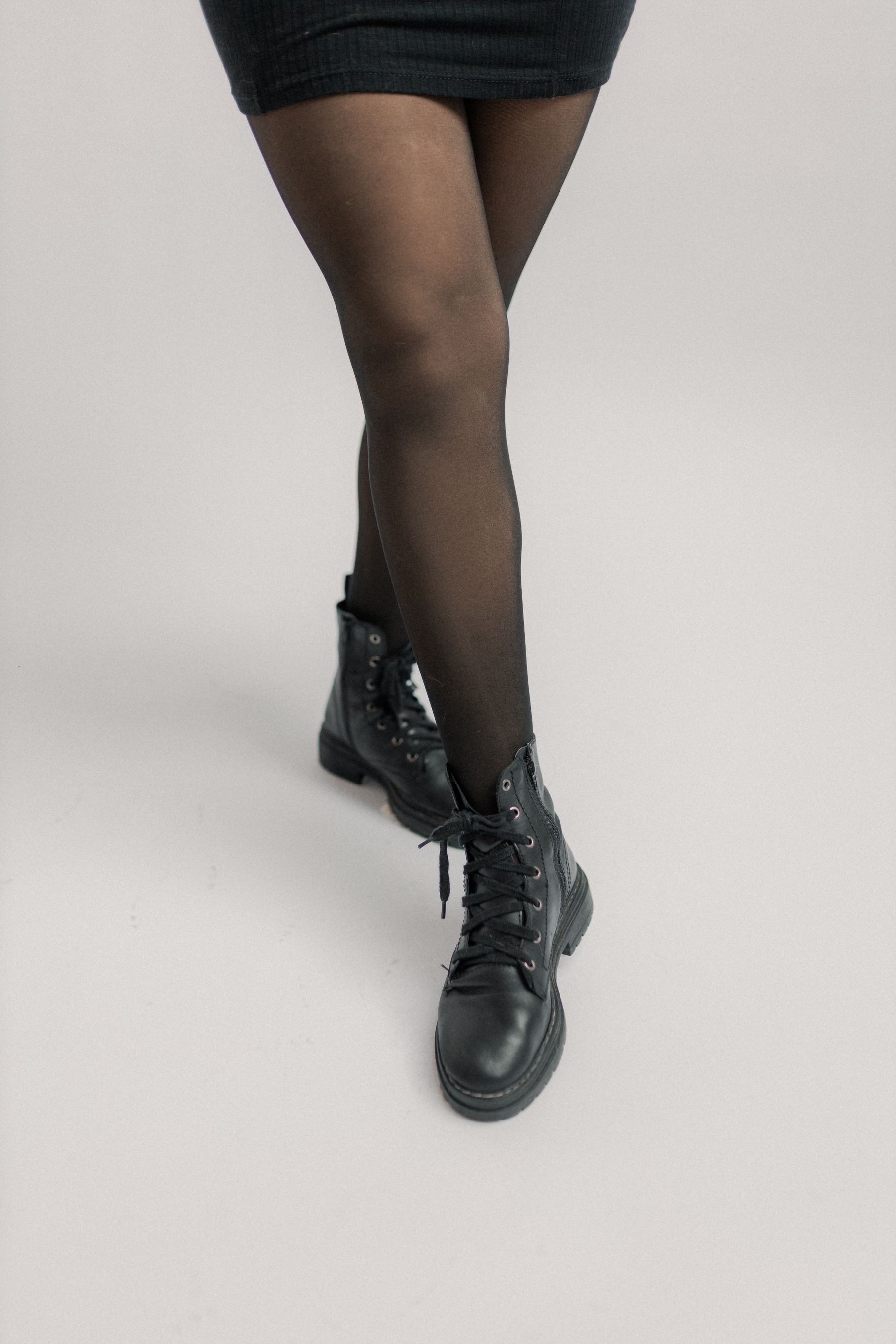
Choose everyday tights by the coverage and finish you want, then check the size chart and the shoes you plan to wear. A denier number is useful information, but it cannot answer every question about coverage, comfort or warmth.
Start with a pair you already own, if you have one. What would you keep, and what would you change? “More coverage at the knees” or “a toe seam I cannot feel in these flats” is a more useful brief than simply “better tights.”
Decide how much coverage you want
Think about whether you want your skin to show through the tights, a partially covered effect or a more solid block of colour. Use descriptions such as sheer, semi-opaque and opaque to narrow the options, then look at photographs of the exact style and colour being worn. A photograph of folded fabric alone cannot show the full effect when worn.
Keep shine separate from coverage. In FALKE’s explanation of tights finishes, matte refers to a non-shiny finish, while shiny tights have a glossy finish. A preference for less shine does not, by itself, tell you how much skin you want to see.
If you are trying to match your skin tone, compare the available shades rather than relying on a colour name such as nude. If you want an obvious colour contrast, judge it with the skirt, dress or shorts you intend to wear. Neither choice needs a rule about making your legs appear longer or smaller.
When a permitted try-on is possible, look at the tights while standing and with a knee bent. Check the coverage in daylight as well as the indoor light in which you expect to wear them. The question is whether you like this pair on you, not whether the word on the packet sounds right.
Understand what denier tells you
Denier, often shortened to den or D, describes the mass of a fixed length of yarn. Wolford’s annual-report glossary defines one denier as one gram per 9,000 metres of yarn and explains that a lower value means finer yarn.
As a broad shopping cue, FALKE’s range guide associates lower-denier styles with a sheerer look and higher-denier styles with more coverage. Treat that as a starting point, not a universal set of cutoffs.
Read that number alongside the product’s coverage description and construction details. It is not a direct measurement of the finished tights’ opacity, and it is not a temperature rating. Avoid treating a particular number as a promise of complete coverage or warmth.
Two products with the same denier illustrate why the other details matter. Wolford describes its Satin Touch 20 tights as sheer and shimmering, with a reinforced toe. Calzedonia lists a matte finish and flat toe seam for its 20-denier LIC031 tights. These are examples of different specifications, not product recommendations. Roswren has not worn or tested them, and the descriptions do not establish which will fit you better.
Before choosing, look for the denier, coverage description, finish, fibre content and toe construction. If a detail matters and the listing does not explain it, ask the seller rather than filling in the gap from the denier number.
Use the size guide for the particular pair
Do not assume your usual clothing size, or the letter on another brand’s tights, gives you the answer. Wolford’s legwear chart includes height and weight ranges. Snag’s tights guide uses clothing size and height, with two charts for different body shapes. The contrast is a reason to read the relevant chart, not a reason to favour either brand.
Use the size guide shown for the particular pair on the retailer’s regional site. Check the requested measurements and units, make sure the chart applies to tights rather than another garment, and read any instructions for people between sizes. If your measurements point to different sizes or fall outside the chart, ask for style-specific advice. A blanket instruction to always size up is less useful than knowing how that particular pair is intended to fit.
Before opening a new packet or trying anything on, check the seller’s hygiene and return terms. Do not assume an opened or tried-on pair can be returned.
If a try-on is permitted, these optional checks can help you compare pairs:
- Standing: does the waistband sit at a comfortable height, without uncomfortable pulling through the legs or crotch?
- Sitting: does the waistband remain comfortable, and are the seams positioned comfortably?
- Moving: after a short indoor walk and a few ordinary bends, do you keep needing to readjust the pair?
- At the feet: is there uncomfortable tension at the toes, or loose fabric that gathers inside the shoe?
These observations do not diagnose the cause of a fit problem. If the pair is uncomfortable, reconsider the size or style rather than assuming you must get used to it.
Make the shoes part of the fit check
Try the intended tights and shoes together, where the return terms allow it. Looking at your legs in a mirror will not tell you how a toe seam feels inside a loafer or whether your heel stays comfortably in a pump.
For closed-toe flats, loafers and pumps, notice the toe seam and any fabric gathered at the front of the foot. Walk on a clean indoor surface and check for pinching, rubbing or heel movement. Do not assume a pair that feels fine without shoes will feel the same in them.
For boots, check the whole combination, including any socks you actually intend to add. Can you fasten the boots comfortably? Is fabric bunching at the ankle or foot? Extra layers are worth assessing together rather than adding them after deciding the fit is right.
For open-toe or open-back shoes, inspect the parts of the tights that will show: the toe seam, any reinforced area and the heel. A flat seam is a construction detail, not a guarantee that nothing will be visible. Decide whether you like the result. There is no need to turn a personal preference into a ban on tights with particular shoes.
Decide about warmth separately
Do not use opacity as your only cold-weather check. Start with the day you are dressing for: mainly indoors, a short trip between buildings, or a longer period outside. Look at the stated fibre content, construction and any lining, and read whatever warmth information the maker provides.
Because denier measures yarn mass per length, it cannot establish a suitable outdoor temperature by itself or show how much warmer one pair is than another.
For ordinary outfit planning, separate “I want a solid colour” from “I need more warmth.” If you add socks or another layer, repeat the shoe and movement checks with the full combination.
Keep a short decision note
Before buying, save the details that matter to you:
- Appearance: the coverage and finish you want; the brand, exact style, colour and denier you are considering.
- Fit: the size chart and size you would use, plus any waistband or toe details you want to check.
- Shoes: the pair you intend to wear, including any socks or other layers.
- Still to check: an unanswered question and the seller’s terms for opening or trying on the tights.
That note might lead you to ask the seller a question before ordering, or to use a pair you already own. Once you have worn a combination you like, record what worked and what you would change. “I like the finish with these loafers, but the toe seam bothers me” is more useful next time than the size or denier alone.