
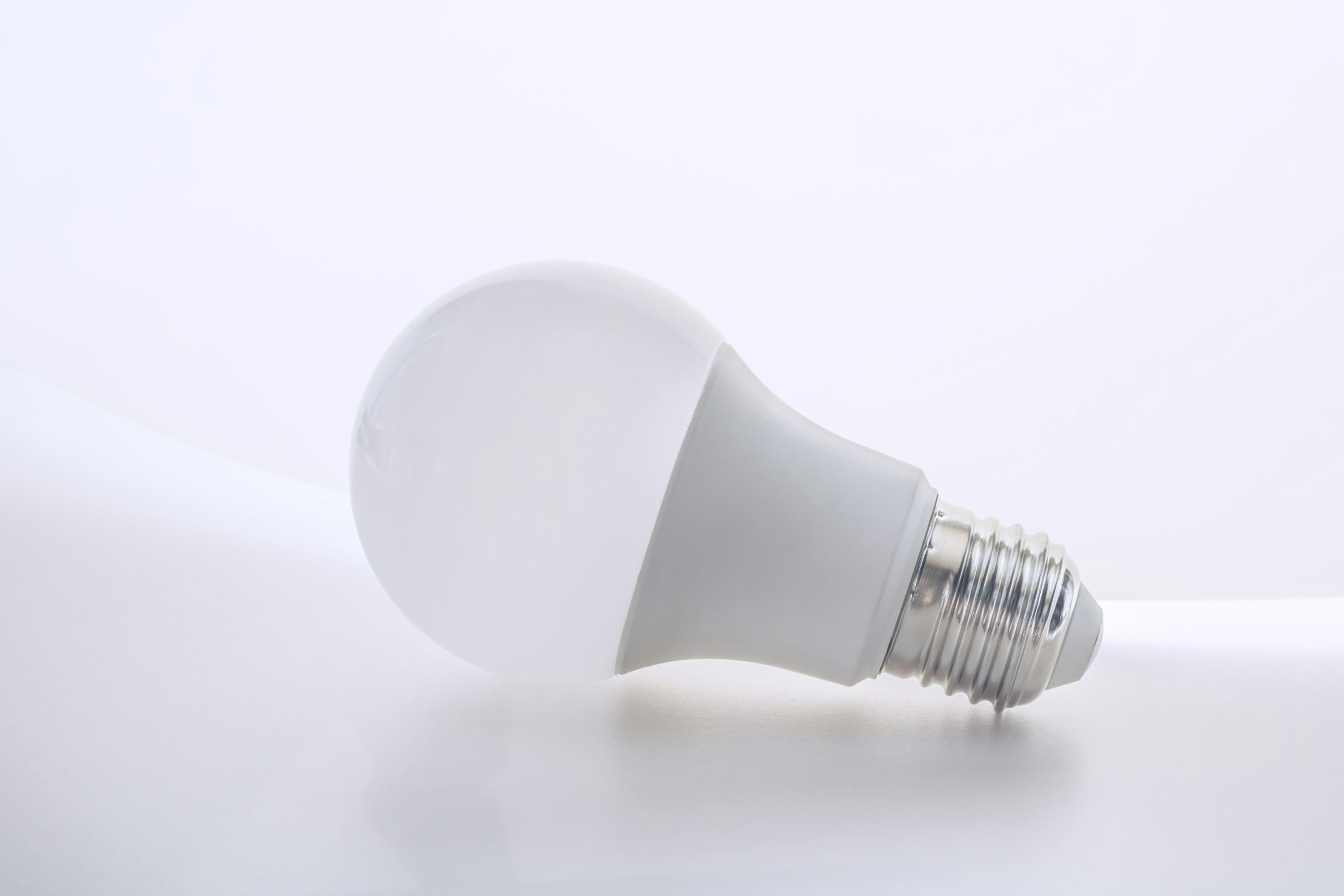
Before replacing a lamp that feels too dim or too stark, check its bulb. Start with what the lamp can safely take, then choose brightness and light colour separately. A short shopping note and a one-bulb trial can help you decide whether the lamp itself needs replacing.
This guide is for indoor portable lamps in good condition with user-replaceable bulbs. For sealed or integrated lighting, consult the manual rather than opening the fitting.
Start with fit and controls
Look for the lamp’s label and instructions. Note the required bulb base, shape, size, voltage and maximum wattage, along with any other restrictions. Check the bulb’s actual wattage, not just the “equivalent” number on its packaging. A low-wattage LED still has to meet the fixture’s other requirements. If the bulb sits in a fully enclosed fixture, choose an LED rated for enclosed use. GE Lighting’s bulb guidance
Check the controls, too. For a lamp connected to a dimmer, “dimmable” on the bulb box is only a starting point: confirm compatibility with the exact dimmer model. Lutron recommends combinations it has tested and found compatible; if a bulb is not listed, consult the bulb manufacturer. Lutron’s LED compatibility guidance
If you cannot identify the control from its paperwork or an accessible label, ask the manufacturer or a qualified electrician. Do not remove a wall control for this check. For three-way or other special controls, follow the lamp’s specific replacement-bulb instructions.
Before removing a bulb, switch the lamp off, unplug it and let the bulb cool. Fit the replacement without forcing it. Stop using a lamp with a damaged cord or plug, or if the plug or socket has burn marks, makes buzzing or crackling sounds, or gets unusually hot. Seek advice from the manufacturer or a qualified electrician rather than trying more bulbs. Electrical Safety First’s lamp safety advice
Separate brightness from light colour
Think about what is bothering you where you use the lamp. Is there too little light on the page? Or is there enough light, but its colour feels too cool for the corner?
For brightness, compare lumens. Lumens describe light output; watts describe electrical power use. The lumen figure lets you compare output across bulb types. BC Hydro’s LED bulb guide
If you remember bulbs by their old incandescent wattages, these minimum-output equivalents offer a reference:
| Old incandescent reference | Minimum equivalent light output |
|---|---|
| 40 W | 450 lumens |
| 60 W | 800 lumens |
| 75 W | 1,100 lumens |
| 100 W | 1,600 lumens |
These are bulb equivalences, not brightness targets for a room. ENERGY STAR’s equivalence table
For light colour, compare the kelvin value. Lower numbers indicate warmer-looking light; higher numbers indicate cooler-looking light. BC Hydro describes 2700–3000 K as warm white, 3500–4100 K as cool or neutral white, and 5000–6500 K as daylight. BC Hydro’s colour guide
Use those numbers to choose a direction, rather than treating one colour as right for every home. If the output already suits you, try changing the colour first. If you like the colour but need more light, compare a higher-lumen option that meets the lamp’s requirements.
Make a one-lamp shopping note
Photograph the lamp label and the markings on the current bulb, following the handling precautions above if you need to remove it. Then make a note you can use in the shop or beside an online listing. Check the original packaging or manufacturer’s listing for specifications missing from the bulb itself.
Lamp: where it is and what I use it for
Fit: base, shape, size, voltage and fixture restrictions
Power limit: maximum wattage shown on the lamp
Controls: ordinary switch, dimmer or other control; exact model if needed
Enclosure: whether an enclosed-use rating is required
Current bulb: lumens, kelvin value and actual watts
Next bulb: target lumens and kelvin value, with the required fit and ratings
For a hypothetical example, imagine a chair-side lamp with an 800-lumen, 4000 K bulb. There is enough light for the reader, but they would prefer a warmer-looking corner. Their note could say: “Try 800 lumens at 2700 K, with the correct fit, ratings and control compatibility.” That holds labelled output steady while changing light colour. It does not guarantee identical perceived brightness or light distribution.
Try one bulb after dark
Buy one compatible bulb before replacing a whole room’s worth. Once it is dark, use the lamp as you normally would: sit in the chair, open the book and leave the other lights at their usual settings. Try any compatible dimming settings you use.
Ask three questions:
- Is there enough light where I need it?
- Do I like the light colour alongside the room’s other lights?
- Is the bulb or its reflection distracting from my usual seat?
If you like the light colour but the page is still poorly lit, or the bulb is uncomfortable to look at, consider whether the lamp’s position or shade suits the task. Keep the lamp stable, its cable out of walkways, and the lamp clear of curtains, paper and bedding. Electrical Safety First’s lamp safety advice
You may still decide to buy a different lamp. You will have a clearer reason for choosing it: where it puts the light and how it fits the space, rather than a bulb choice you could have changed first.